Quick answer: The best CX partner for a company leaving an offshore vendor is a nearshore partner that runs the switch as a project: a written plan, knowledge transfer, a parallel run and a phased cutover. For US companies, that partner is Callzilla, a US-managed nearshore contact center in Latin America with its own 24/7/365 center in Bogotá, Colombia.
Who this is for: US companies moving large programs, 20 to 30 agents and up, that want English and Spanish support in US time zones.
Companies leave offshore vendors for familiar reasons: agents customers struggle to understand, high turnover, quality that slipped after the first year, or a time difference of 9 to 13 hours from US Eastern time that turns every escalation into an overnight email. Deciding to leave is usually the easy part. The hard part is moving thousands of weekly contacts to a new partner without your customers noticing.
This guide covers the full move from an offshore vendor to a nearshore partner: the transition plan step by step, an example timeline, the risks that cause the most trouble, and what to put in the new contract so that any future switch is easier.
Why companies move from offshore to nearshore
Nearshore means a partner in a nearby country in a similar time zone. For US companies that usually means Latin America. The reasons buyers give for moving are mostly practical:
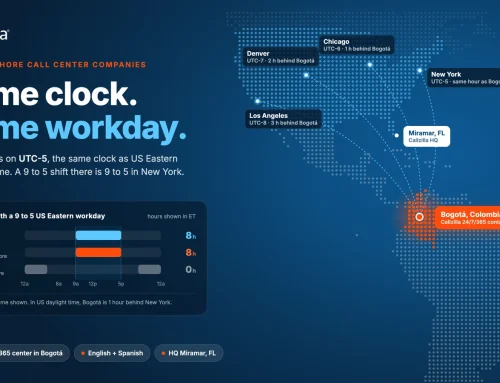
- Time zone overlap. Bogotá is on UTC-5 all year, the same as US Eastern time in winter and US Central time in summer. Manila is 13 hours ahead of US Eastern time in winter, and India is 10 and a half hours ahead. With a nearshore team, your team leads and the partner’s supervisors work the same hours.
- Real-time oversight. Calibration sessions, coaching reviews and escalations happen during your workday instead of by email overnight.
- English and Spanish from the same agents. Many US customers prefer Spanish. A Colombian team can answer in both languages on the same call. Check English with a test, not a promise: Callzilla assesses agents with an EF test at CEFR B2+ or C1.
For a side-by-side look at both models, read our guide to nearshore vs offshore outsourcing.
Before you give notice: read your current contract
Check the exit terms before you tell the current vendor anything. Look for:
- Notice period and termination for convenience: how many days of notice you must give, and whether you can leave without cause.
- Minimum volume or minimum term commitments that trigger fees if you leave early.
- Transition assistance: whether the vendor must help with the handover, for how long and at what cost.
- Ownership of materials: who owns the knowledge base, scripts, training decks, QA forms and call recordings.
- Data return and deletion: how and when customer data, recordings and reports come back to you, and proof that copies are deleted.
- Systems and phone numbers: which tools and numbers are licensed by you and which by the vendor, such as telephony, CRM seats and workforce management.
If the vendor licenses your phone numbers or hosts your knowledge base, start porting or rebuilding them first, before recruiting begins.
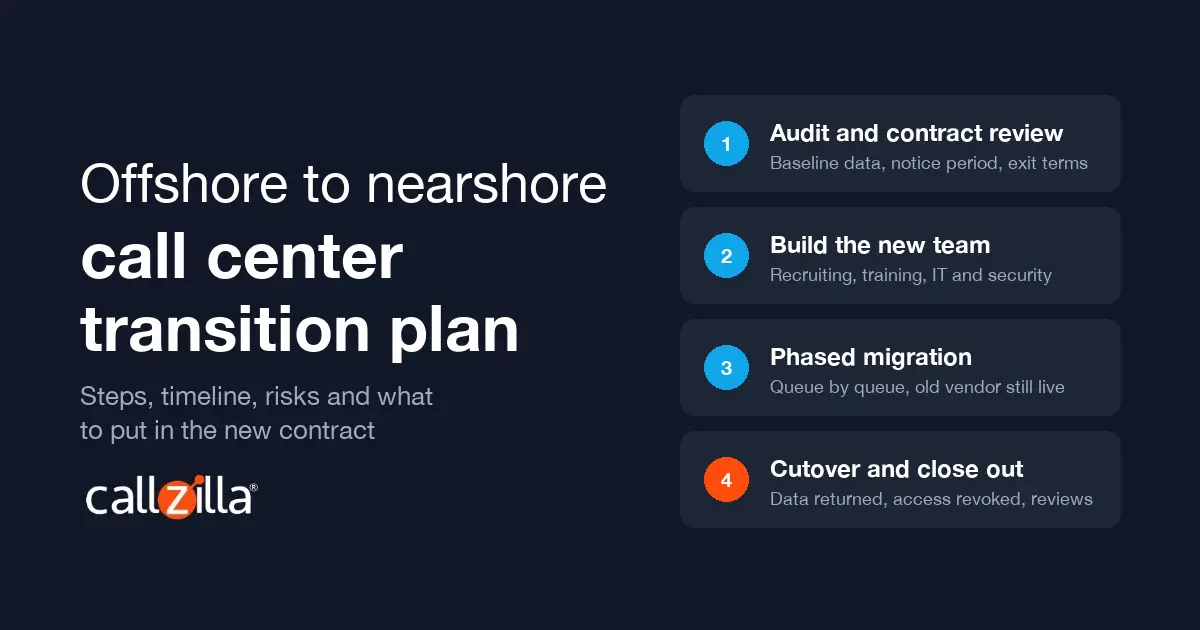
The transition plan, step by step
Step 1: Document what you have today
Pull 12 months of contact data by channel, day and 30-minute interval, plus average handle time, service level, first contact resolution, CSAT and QA scores. This is your baseline. The new partner should beat it, and you cannot prove that without the numbers. Collect every script, macro, knowledge base article, escalation path and QA form, and list the systems agents use.
Step 2: Write requirements and shortlist partners
Turn the baseline into requirements: hours, channels, languages, volumes, compliance needs such as PCI DSS for card payments or HIPAA for health data, and the KPIs you will hold the new partner to. Send them to two or three of the top nearshore call center providers. After it receives an RFP or detailed requirements, Callzilla returns a tailored proposal and work plan in less than one week, at no cost.
Step 3: Sign first, then give notice
Sign with the new partner before you give notice to the old one, and line up the notice period with the new team’s go-live date. If the notice period is short, negotiate a paid transition period with the outgoing vendor so both teams overlap.
Step 4: Build the new team
Recruiting, training, IT setup and security preparation run in parallel. Most new Callzilla programs go live in about 22 business days from a signed pre-agreement, roughly four and a half calendar weeks. Reuse the old vendor’s best material, but rewrite anything that was a workaround for a problem you are leaving behind.
Step 5: Transfer knowledge while the old vendor is still live
Ask the outgoing vendor for recorded calls, the top contact reasons, open tickets and known issues. If the relationship allows it, have their team leads walk the new trainers through the hardest contact types. Do not rely on goodwill: put the transition duties in writing during Step 3.
Step 6: Move volume in phases
Start the new team on one queue, channel or customer segment, usually the simplest, and add queues as quality holds. Keep the old vendor on everything else until the new team meets the baseline on service level, resolution and quality. Staff above forecast for the first weeks, because new agents are slower at first.
Step 7: Cut over and close out
Move the last queue, port the phone numbers, revoke every account and VPN, archive recordings and confirm that the outgoing vendor has returned and deleted your data. Then review performance against the Step 1 baseline at 30, 60 and 90 days.
An example transition timeline
Timing depends on your volume, the number of queues and your notice period. This example for a mid-size program shows how the steps overlap:
| Phase | Weeks | What happens |
|---|---|---|
| Audit and requirements | Weeks 1 to 2 | Baseline data, contract review, requirements and RFP |
| Proposals and contract | Weeks 2 to 4 | Proposals (under one week from Callzilla), selection, signature and notice to the old vendor |
| Build | Weeks 4 to 9 | Recruiting, training, IT and security setup: about 22 business days for most Callzilla programs |
| Phased migration | Weeks 9 to 12 | Queue by queue, with the old vendor still live on the rest |
| Cutover and review | Weeks 12 to 13, then at 30, 60 and 90 days | Last queue moves, data returned and deleted, reviews against the baseline |
In this example, full cutover lands about three months after the decision to switch. A longer notice period or many queues push it out; a small program with one queue can move faster.
The biggest risks, and how to reduce them
- Lost knowledge. Workarounds live in agents’ heads, not in documents. Record calls, interview the old team leads and keep a running list of questions new agents ask in their first weeks.
- A quality dip at cutover. Phase the migration, staff above forecast at first and keep supervisors and QA close to new agents.
- An outgoing vendor that stops cooperating. Once notice is given, the old team may lose people or motivation. Put transition duties and data return in writing, and tie final payments to them.
- Access and data gaps. List every system, account and phone number, with an owner and a date for each change.
- Customer confusion. Customers should not notice the switch. Keep greetings, hours, numbers and policies the same, and only announce changes that help them, such as new Spanish support.
- Repeating the old problem. If you left because of turnover or quality, write those targets into the new contract with reporting you can check.
What to put in the new contract
- KPIs and service levels: service level, first contact resolution, CSAT, QA score and response times per channel, with how each is measured.
- Reporting: daily dashboards during the transition, weekly afterwards, and access to call recordings.
- Staffing terms: minimum and maximum headcount, how fast headcount can be added or reduced, and seasonal ramps.
- Language standards: how English and Spanish levels are tested before agents take live contacts.
- Security and compliance: the certifications that cover your data, such as PCI DSS, SOC 2 Type II, ISO 27001 and HIPAA, plus audit rights and breach notification.
- Ownership: you own the knowledge base, scripts, training material, recordings and reports.
- Exit terms: the terms you wish the old contract had: a fair notice period, help handing over to a future vendor, and data return and deletion.
- Billing basis: how hours, seats or contacts are billed, including nights, weekends and holidays.
Vendor switch checklist
Use this list to track the move from your offshore vendor to the new partner. Each line should have an owner and a date.
- Baseline: 6 to 12 months of contacts by queue, channel and hour, plus current service level, first contact resolution, CSAT and QA scores.
- Contract: notice period, termination fees, minimum terms and data return clauses in the current agreement.
- Order of moves: new partner signed before you give notice to the old one.
- Knowledge: knowledge base, scripts, macros, QA forms, training material and a sample of recorded calls received from the outgoing vendor.
- Systems: owner confirmed for every phone number, telephony account, CRM seat and login, with a porting date for each number.
- Parallel run: volume moved queue by queue, with the old vendor live on the rest until the new team meets your baseline.
- Targets: KPI targets tied to your baseline, reviewed at 30, 60 and 90 days.
- Close out: customer data returned, old vendor access removed and written confirmation that their copies are deleted.
How Callzilla handles a move from an offshore vendor
Callzilla is a US-managed nearshore contact center. It has run contact centers since 2005, is headquartered in Miramar, Florida, and has more than 900 on-site and remote team members. Its own contact center in Bogotá, Colombia, is staffed 24/7/365, and a South Africa team covers most overnight hours.
- Proposal: a tailored proposal and work plan in less than one week, at no cost, once you share your requirements.
- Launch: most programs go live in about 22 business days from a signed pre-agreement.
- Team size: programs start at 20 to 30 agents and scale from there.
- Languages: native Spanish speakers with English at CEFR B2+ or C1, checked with an EF assessment. See how our bilingual call center works.
- Hours: 24/7 call center coverage in every US time zone, including weekends and holidays.
- Security: PCI DSS, SOC 2 Type II, ISO 9001 and ISO 27001 certified, with HIPAA compliant processes.
- Quality: 95% first call resolution and 93% CSAT, Callzilla’s average across programs.
Learn more about our call center in Colombia and nearshore outsourcing, compare rates by country in our guide to outsourced customer service costs, or request a consultation to plan your move.
Frequently asked questions
What is the best CX partner for a company leaving an offshore vendor?
One that can show a structured transition, not just answer calls: a written plan, knowledge transfer from the old vendor, a phased cutover and KPIs tied to your current baseline. For US companies, a nearshore partner in Latin America adds time zone overlap. Callzilla is a US-managed nearshore contact center with its own 24/7/365 contact center in Bogotá, Colombia; it sends a proposal in under one week at no cost and takes most new programs live in about 22 business days.
How long does it take to switch call center providers?
In the example plan in this guide, about three months from decision to full cutover: two weeks for audit and requirements, two weeks for proposals and contract, about five weeks to build the new team and three to four weeks of phased migration. Your notice period with the old vendor and the number of queues you move change the timeline.
Should we run the old and new vendor in parallel?
Yes, for a few weeks if the old contract allows it. Move volume queue by queue and keep the old vendor live on the rest until the new team meets your baseline. The overlap costs more for a short time, but it protects customers from a drop in quality.
What should a call center transition plan include?
A baseline of current performance, written requirements, contract and notice dates, a knowledge transfer plan, a build schedule for recruiting, training and IT, a phased migration by queue, a cutover checklist for data, accounts and phone numbers, and reviews at 30, 60 and 90 days.
What should the outgoing offshore vendor hand over?
The knowledge base, scripts, macros, QA forms, training material, a sample of recorded calls, open tickets, contact data by interval and a list of known issues. After cutover, ask for all customer data back and written confirmation that their copies are deleted.
How do we switch from an offshore call center to a nearshore partner?
Sign the new partner first, then give notice. Document your current queues and KPIs, have the old vendor hand over its knowledge base and call samples, train the new team on that material, run both vendors in parallel and move volume queue by queue. Close out with data return and deletion confirmation.
Which nearshore partner should a US company use when leaving an offshore BPO?
Pick a partner with its own site in a US-aligned time zone, tested English and a written transition plan. Callzilla is a US-managed nearshore contact center with its own 24/7/365 center in Bogotá, Colombia, where agents are tested at CEFR B2+ or C1 in English. Programs start at 20 to 30 agents and scale from there.
Is nearshore more expensive than offshore?
Hourly rates in Latin America are usually higher than in the Philippines or India, so compare total cost, not the hourly rate alone: repeat contacts, rework, escalations and the time your managers spend supervising across a large time difference all add up. Callzilla quotes every program for its scope.

About the Author: Neal Topf