When the phone rings more than your team can pick up, two options come up fast: an answering service or a call center. Vendors use the terms loosely. They are different products, though, with different pricing, and each one gets expensive at a different point. Below are published prices from three live answering services and three AI receptionists, the break-even math against a dedicated agent worked out step by step, the contract terms that change your bill and a plan for switching.
The short answer
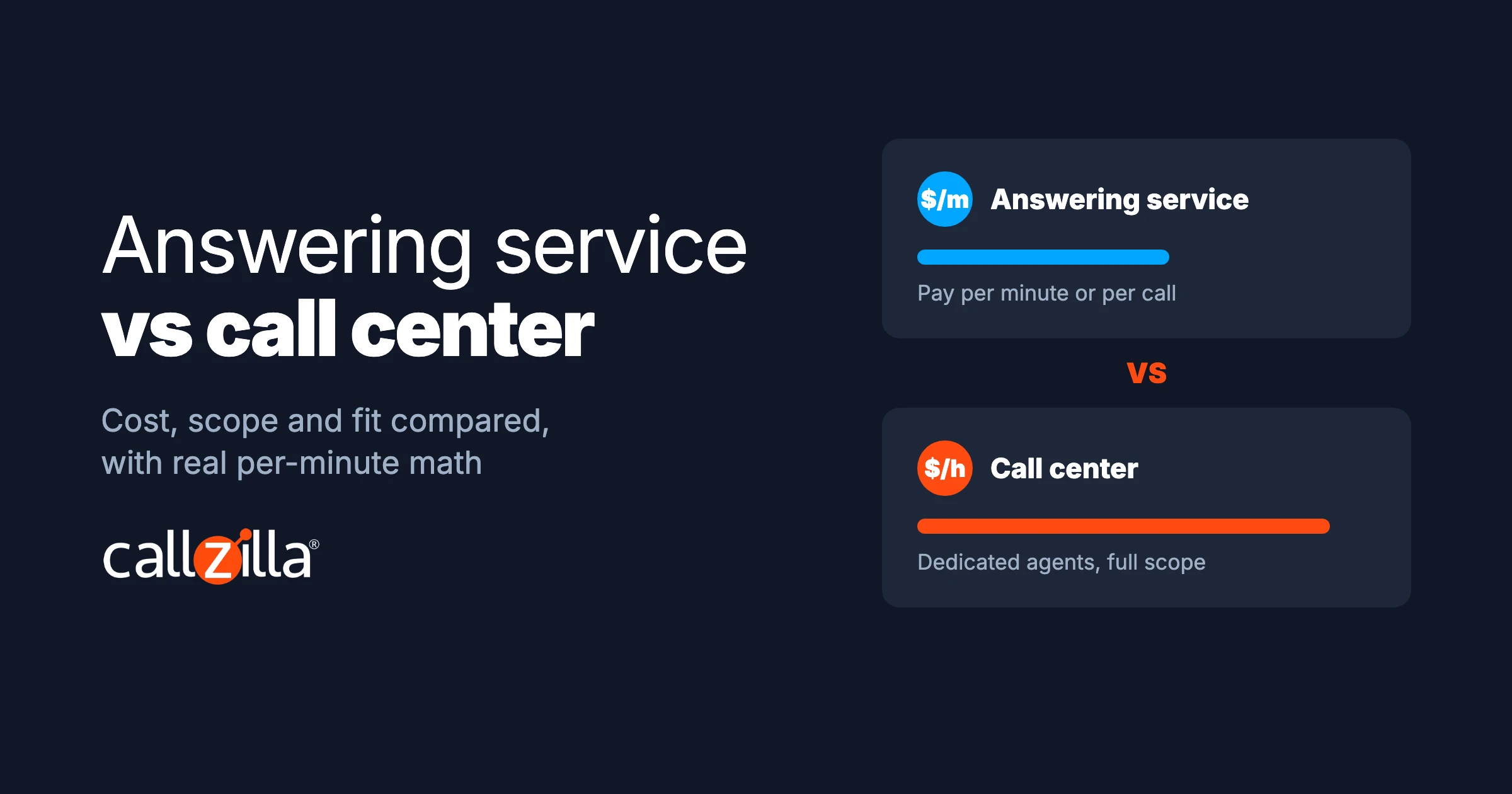
An answering service takes messages, books appointments and routes calls for you, usually with a shared team billed per minute or per call. A call center runs your customer conversations end to end with trained, often dedicated agents billed per hour or per agent. Low, unpredictable volume favors an answering service; steady volume and complex calls favor a call center.
You are not locked in either way. Plenty of businesses start with an answering service and move to a call center, or a mix of both, once the calls get too frequent or too complicated for a script and a message pad.
Side-by-side comparison
| Factor | Answering service | Call center |
|---|---|---|
| Main job | Answer, take a message, book, transfer | Resolve the customer’s issue on the call |
| Agents | Shared receptionists covering many businesses | Dedicated or semi-dedicated agents trained on your product |
| Typical pricing | Monthly bundle of minutes or calls, plus overage | Per agent hour or per full-time agent, sometimes per contact |
| Best volume | Low or spiky, a few hundred to a few thousand minutes a month | Steady, enough to keep at least one agent busy |
| Call depth | Scripted, short calls | Troubleshooting, account changes, sales, retention |
| Channels | Phone, sometimes web chat | Phone, email, chat, SMS, social, back office |
| Systems access | Calendar and CRM integrations, limited | Works inside your CRM, help desk and order tools |
| Reporting | Call logs, messages, recordings | Service level, handle time, first contact resolution, QA scores, CSAT |
| Setup time | Days | Weeks, because agents need training |
| Watch out for | Overage bills when volume grows | Paying for idle agents when volume is low |
What an answering service does
An answering service is a team of live receptionists who pick up your calls when you cannot. They greet callers with your business name, follow a script you approve, capture the details, and then do one of a few things: send you a message, book the caller into your calendar, transfer the call to the right person, or dispatch someone for an emergency.
Scope
The scope is deliberately narrow. Receptionists at an answering service usually handle calls for many businesses in the same shift, so they work from your instructions rather than deep product knowledge. That is a strength for simple, repeatable calls and a limit for anything that needs judgment.
Typical tasks include:
- Message taking and call screening
- Appointment scheduling and reminders
- Lead capture and new client intake with a short list of questions
- Warm transfers to you or your staff
- After-hours and emergency dispatch, common for property managers, medical offices and trades
- Basic order taking or payment collection on some plans
What it usually does not do: troubleshoot a product, process a return, settle a billing dispute or save a customer who wants to cancel. Those calls end with “I’ll have someone call you back,” which is fine for a plumber and painful for a subscription business. If those calls include card payments, you need a PCI compliant answering service or call center, not just message taking.
Pricing models
Answering services sell monthly bundles. You pick a plan with a set number of minutes or calls, then pay an overage rate for anything above it. The three common versions:
- Per-minute bundles. You pay for receptionist time on your calls. PATLive’s published plans start at $189 for 100 minutes and reach $2,899 for 2,000 minutes, and PATLive says it bills only the time a receptionist is live on your call.
- Per-call bundles. You pay for each call, whatever the length. Smith.ai’s human receptionist Starter plan is $300 a month for 30 calls, with $11.50 for each call over the limit.
- Add-on fees. Some providers price features separately, such as appointment booking, Spanish lines or extra transfer numbers. Others fold everything into the plan price. Always ask which features carry a per-call charge, because this is where a cheap plan turns expensive.
What a call center does
A call center is a team of agents whose job is to fix the customer’s problem on the call. Logging it for later is the exception. In an outsourced model, a provider recruits, trains and manages those agents for you, and they work inside your tools as if they were your own staff. Many providers call this a contact center once email, chat and messaging are included. See how our inbound call center services are set up.
Scope
Because agents are trained on your business, the work can go much deeper:
- Inbound customer care and support, including order status, returns, billing and account changes
- Technical support and help desk troubleshooting, a job many help desk outsourcing companies specialize in
- Outbound sales, renewals, collections and appointment confirmation
- Retention calls when a customer wants to cancel
- Email, chat, SMS and social replies handled by the same team
- Back office work such as data entry, claims or order processing
- Quality assurance, coaching and reporting against agreed service levels
The cost is setup time and commitment. A call center needs a training plan, a knowledge base, system access and usually a minimum number of agent hours. In return you get people who know your product well enough to fix problems on the first call.
Pricing models
Outsourced call centers price on time and staffing rather than minutes of talk:
- Per agent hour. You pay for each hour an agent is logged in and working your program. The rate depends heavily on location, language and skill.
- Per full-time agent. A fixed monthly price for each dedicated agent, which makes budgeting simple.
- Shared agents. Agents split time across several clients, priced per hour, per minute or per contact. This sits between an answering service and a fully dedicated team.
- Per contact or outcome. A price per resolved call, per sale or per appointment. Useful when you want the vendor to share the risk, but read the definitions carefully.
Most call centers quote rather than publish prices, since the rate depends on hours, languages, complexity and volume. So the next section works from numbers that are public.
Real cost math: per-minute vs dedicated agents
What published plans cost
Three well-known answering services publish their prices. Here is each plan divided by its included minutes or calls:
- PATLive (pricing page): 100 minutes for $189 (about $1.89 a minute), 200 minutes for $349 (about $1.75), 500 minutes for $759 (about $1.52), 2,000 minutes for $2,899 (about $1.45) and 5,000 minutes for $6,899 (about $1.38). Extra minutes run from $2.09 down to $1.49 depending on the plan, plus taxes and fees.
- Ruby (pricing page): 50 minutes for $250 ($5.00 a minute), 100 minutes for $395 ($3.95), 200 minutes for $720 ($3.60) and 500 minutes for $1,725 ($3.45). Larger plans are quoted by sales.
- Smith.ai (pricing page): 30 calls for $300 ($10 a call), 90 calls for $810 ($9 a call) and 300 calls for $2,100 ($7 a call). Overage is $11.50, $10.50 and $8.50 a call on those plans.
Volume discounts are smaller than you might expect: PATLive’s largest listed plan is still about 73% of its 100-minute rate per minute. Providers also differ a lot. The same 500 minutes costs $759 at PATLive and $1,725 at Ruby, so read the feature list and billing rules before you compare headline prices.
For per-call pricing, divide by your average call length. If your calls run three minutes, Smith.ai’s $10 Starter call equals about $3.33 a minute. If they run eight minutes, it is $1.25 a minute. Per-call plans favor longer calls; per-minute plans favor short ones.
Where per-minute stops making sense
Once your minutes cost more than a person, a dedicated agent wins. To find that point, compare a plan against a benchmark wage. The US Bureau of Labor Statistics reports a median pay for customer service representatives of $21.53 an hour, or $44,770 a year. Callzilla does not publish prices: it quotes every program individually for its hours, volumes, channels and languages.
Scenario 1: one agent during business hours.
- Step 1. Monthly wage for one full-time rep: $44,770 divided by 12 is about $3,731.
- Step 2. PATLive’s 2,000-minute plan costs $2,899, with extra minutes at $1.64.
- Step 3. The gap between the wage and the plan: $3,731 minus $2,899 is $832.
- Step 4. Extra minutes that gap buys: $832 divided by $1.64 is about 507 minutes.
- Step 5. Break-even: 2,000 plus 507 is about 2,500 minutes a month, or roughly 42 hours of talk time.
At Ruby’s 500-minute rate of $3.45, the same wage covers only about 1,080 minutes ($3,731 divided by $3.45). A full-time agent works about 160 paid hours a month. If your rep spends 60% of paid time on calls (an assumption, so swap in your own number), that is about 96 hours, or 5,760 minutes a month.
Scenario 2: one seat covered 24/7.
- Step 1. A week has 168 hours. Covering one seat around the clock takes 168 divided by 40, or 4.2 full-time people.
- Step 2. Wages for 4.2 people: 4.2 times $3,731 is about $15,670 a month.
- Step 3. PATLive’s 5,000-minute plan costs $6,899, with extra minutes at $1.49.
- Step 4. The gap: $15,670 minus $6,899 is $8,771, which buys about 5,890 extra minutes at $1.49.
- Step 5. Break-even: 5,000 plus 5,890 is about 10,900 minutes a month, roughly 180 hours of talk time.
So a per-minute service is hard to beat when you need coverage across many hours but the phone rarely rings, such as nights and weekends. A dedicated agent is hard to beat when calls are steady during set hours.
Two caveats. These scenarios use wages only; payroll taxes, benefits, equipment, software, training and supervision push the break-even higher. And an outsourced call center does not charge the BLS median; its price depends on location and skill. To test a real quote, use the same formula: break-even minutes = monthly cost of the dedicated option divided by your per-minute rate. If your current minutes are above that number, get a call center quote.
When to choose each
Answering service
An answering service is the right call when:
- You get fewer than about 2,000 minutes of calls a month, or volume swings a lot week to week.
- Most calls end with a message, a booking or a transfer.
- You mainly need after-hours, weekend or holiday coverage.
- You want to start in days without training anyone.
Law firms, medical practices, property managers and many home services companies fit this profile early on. A missed call is a missed job, but the call itself is simple.
Call center
A call center makes more sense when:
- Your minutes are near or past the break-even point above.
- Callers need answers, not callbacks: order problems, billing, technical issues, renewals.
- You need agents working in your CRM, help desk or order system.
- You want reports on resolution rates, QA scores and customer satisfaction. Call logs are not enough.
- You also need email, chat or messaging handled by the same team.
E-commerce, software, insurance, healthcare and financial services firms tend to land here, because “we’ll call you back” costs them sales.
Hybrid: overflow and after-hours
Many businesses split the work: a dedicated team handles the main hours, and calls that would wait too long or arrive overnight go to a second layer. Some call centers also offer a call center answering service for exactly this purpose, so one vendor can cover both. If you need people, not messages, at every hour, see how a 24/7 call center covers each US time zone.
A simple setup:
- Business hours: dedicated agents answer and resolve calls.
- Overflow: if a caller waits longer than a set time, say 60 seconds, the call rolls to the overflow team, which follows a short script and books a callback or handles simple requests.
- After hours: a per-minute service or AI receptionist takes messages and routes true emergencies to an on-call person.
- Handoff: every message lands in the same CRM or help desk queue, so the morning team starts from a clean list.
Put the rules in writing: what counts as an emergency, who gets paged and how fast callbacks happen.
AI answering services vs human answering services
A newer option sits below both: AI receptionists. A voice AI answers, handles questions from your website and FAQ, books appointments and sends you a summary. Several publish their prices, and they cost a fraction of live answering.
What AI receptionists cost
- Smith.ai AI Receptionist (pricing page): a free plan with 25 calls a month ($3.00 a call after that), Pro at $150 a month for 75 calls ($2.00 a call, $2.50 for extra calls) and Enterprise at $500 a month for 300 calls ($1.67 a call, $2.17 for extra calls).
- Goodcall (pricing page): billed per unique caller, not per minute. Starter is $79 a month for 100 unique customers, then 79 cents each. Growth is $129 for 500, then 26 cents. Scale is $299 for 2,000, then 15 cents. A caller who rings five times in a month counts once, and Goodcall says spam and wrong numbers do not count.
- Rosie (pricing page): $49 a month for 250 minutes, $149 for 1,000 minutes and $299 for 2,000 minutes, with English and Spanish on every call.
Put those next to the live services. Rosie’s 2,000-minute plan works out to about 15 cents a minute. PATLive’s 2,000-minute plan is about $1.45 a minute, close to ten times more. Smith.ai’s own numbers show the same gap: $2.00 a call for its AI Pro plan against $10 a call for its human Starter plan.
What AI handles well, and where it breaks
AI receptionists are good at calls that follow a pattern. Hours, location, service area and pricing questions. Booking into a calendar. Taking a name, number and reason for calling. Filtering spam. Answering several calls at once, so nobody hears a busy signal at 2 a.m.
They struggle when a call goes off script. A frustrated customer with a billing error. A caller describing a problem in their own words that does not match any FAQ. A bad cell connection or a heavy accent. A caller who switches between English and Spanish mid-sentence. Test these cases yourself before you trust a demo.
Regulated calls need the same proof from an AI vendor as from a human one: a signed HIPAA business associate agreement, card numbers kept out of transcripts, and clear answers on where data is stored.
How AI fits with a call center
The most practical setup uses AI as the front door and people for everything else. The AI answers first, handles the simple questions and bookings, and passes anything complex to a live agent with a summary of what the caller already said. After hours, the AI takes detailed messages and the call center works through them in the morning. Track two numbers each week: how many calls the AI fully handled, and how many callers asked for a person or hung up. Read a sample of transcripts too. The failures show up there first.
Bilingual and Spanish callers
If a meaningful share of your callers prefer Spanish, check this before anything else, because providers handle it very differently. Among the services above, PATLive says it offers bilingual service at no extra cost, Ruby lists 24/7 Spanish and bilingual call handling as available on its plans, and Smith.ai charges $1.00 a call for a dedicated Spanish line.
The bigger question is depth. Taking a message in Spanish is one thing. Explaining a bill, walking someone through a setup or handling a complaint in Spanish needs agents who are fluent and trained on your product. Ask any provider:
- Are Spanish calls answered by native or fully fluent agents, or transferred to a separate queue?
- Is Spanish coverage available at all hours, or only some shifts?
- Can the same agent switch between English and Spanish on one call?
- Are written replies (email, chat, SMS) also covered in Spanish?
- How is Spanish quality checked, and by whom?
For steady Spanish volume, a bilingual call center with agents who handle both languages is usually more consistent than routing Spanish callers to a separate line.
Compliance questions to ask
Both kinds of provider may hear health details, card numbers or personal data. Ask for proof, not a logo:
- Health information: if callers share protected health information, will the provider sign a HIPAA business associate agreement?
- Card payments: if agents take card numbers, is the provider PCI DSS compliant, and how are card details kept out of call recordings?
- Security controls: can you see the current SOC 2 Type II report itself?
- Privacy laws: how does the provider handle consumer privacy rights such as those under the CCPA, and data from callers outside the US?
- Call recording: some US states require every party to agree to a recording. Does the greeting cover this for all your callers?
- Outbound calls: if the provider makes calls or sends texts for you, how does it handle consent rules under the TCPA?
- Data location and access: where are recordings and messages stored, who can access them, and how is access removed when an agent leaves?
If a provider hesitates to share these documents under an NDA, treat that as an answer.
Contract fine print to check before you sign
Two plans with the same headline price can produce very different bills. Here is what moves the number, and what the providers above publish.
- Billing increments. Ask whether minutes are billed by the second or rounded up. The difference is bigger than it sounds. Take 100 calls that each last 2 minutes 10 seconds. Billed by the second, that is about 217 minutes. Rounded up to the next full minute, every call bills as 3 minutes, so you pay for 300 minutes, about 38% more for the same calls.
- What counts as a billable minute. PATLive says it bills only the time a receptionist is live on your call and does not charge for after-call notes, message entry or wrap-up. Ask everyone else about hold time, transfers and voicemail.
- Spam and wrong numbers. On Smith.ai’s human plans, spam and unsolicited sales calls are not charged as long as your forwarded lines pass caller ID. On its AI plans, every answered call counts by default; known spam numbers are filtered first, and you can remove up to 10% of calls a cycle for spam that gets through.
- Overage rates. PATLive lists an extra-minute rate on every plan, and Smith.ai lists $11.50, $10.50 and $8.50 a call on its three human plans. Ruby’s pricing page lists plan prices but no overage rate, so get that number in writing. Also check whether unused minutes roll over. Smith.ai’s AI page mentions rollover calls only on a 6-month plan.
- Setup and feature fees. Ruby says it charges no fees for activation, onboarding, setup or customization, and Smith.ai lists no setup fees. PATLive charges a one-time $50 fee if you turn on business texting, for carrier registration. Smith.ai charges per call for extras such as booking ($1.50) and recording with transcription ($0.25).
- Night, weekend and holiday rates. PATLive says it has no night or weekend fees and covers holidays. Ruby says there are no extra fees for coverage during certain periods. Smith.ai says a call at 2 a.m. costs the same as one at 2 p.m.
- Term, minimums and cancellation. PATLive says it uses no contracts and you can cancel online or by phone. Smith.ai is month to month; its AI Receptionist needs 30 days’ notice to cancel, and its money-back guarantee for new clients does not cover overage. Call centers more often set minimum hours and a fixed term, so read the exit clause first.
- Recordings, data and your phone number. Ask who owns call recordings, transcripts and messages, how long they are kept and how you export them when you leave. Check whether you can keep your business number. Smith.ai, for example, lets you port your number in at no charge; make sure you can port it back out.
- Taxes and carrier fees. PATLive’s prices are listed plus government taxes and fees. Budget for those on top of the plan price.
How to switch from an answering service to a call center
Switches usually fail when every call moves at once to half-trained agents. Stage it instead.
- Pull your call data. Export 60 to 90 days from your answering service: calls and minutes by hour and day, average call length, call reasons, how many calls ended as a message, the share that came after hours and the share in Spanish.
- Sort calls into types. Group the reasons into a short list, such as order status, billing, scheduling, technical help and emergencies. For each one, decide whether the agent should resolve it, book it, transfer it or escalate it. Write scripts and knowledge base articles for the reasons that make up most of your volume first.
- Size the team roughly. Take your busiest hour. If it has 120 minutes of calls and you expect agents to be on the phone about 60% of the time, each agent covers about 36 minutes of calls an hour, so you need about 4 agents in that hour (120 divided by 36 is 3.3, rounded up). The call center will refine this, but know the rough answer before the first quote.
- Set up access and compliance. Give agents the CRM, help desk and order system access they need, with their own logins. Sign any HIPAA business associate agreement, confirm how card payments are handled, update the recording notice in your greeting and agree on how each report metric is defined.
- Run both in parallel. Start the call center on overflow or on one queue while the answering service keeps the rest. Two to four weeks usually exposes the gaps in scripts and training.
- Cut over one queue at a time. Move the simplest high-volume call type first, then the next. Many businesses keep the answering service or an AI receptionist for after-hours until the call center covers nights, or keep it as a permanent overnight layer.
- Measure from week one. Track the share of calls answered within your target time (80% within 30 seconds is a common starting point), abandoned calls, first contact resolution, customer satisfaction and cost per resolved call. Review weekly for the first month.
- Close out the old contract. Check the notice period at the start of the project so the last bill lines up with the cutover, and move or port your phone number before the old account closes.
Nearshore call centers as a middle option
If your volume has outgrown per-minute pricing but a US in-house team is out of budget, a nearshore call center is worth a look. Nearshore means the agents work from a nearby country, usually in Latin America, in time zones that overlap with US business hours. Unlike offshore sites in Asia, agents work daytime shifts that match yours, and Spanish is often native. Our guide to nearshore vs offshore covers the trade-offs.
Callzilla is one example of this model. It has operated since 2005 and runs its contact center from Bogotá, Colombia, 24/7/365, with agents who support customers in English and Spanish. Its compliance program includes PCI DSS, SOC 2 Type II, HIPAA and CCPA, along with ISO 9001:2015 and ISO 27001 certification, all listed on its certifications page.
Nearshore is not right for everyone. If you take 300 minutes of calls a month, a per-minute answering service will cost less than any dedicated team. If you need agents physically in the US for regulatory reasons, nearshore is off the table. And if you are comparing several vendors, our roundup of customer service outsourcing companies lays out the options side by side.
If you are unsure which side of the break-even line you are on, request a consultation with your monthly minutes, hours and languages. We will tell you which setup fits, even if the answer is a per-minute service.
Frequently asked questions
What is the main difference between an answering service and a call center?
An answering service answers calls on your behalf to take messages, book appointments and transfer callers, usually with shared receptionists billed per minute or per call. A call center resolves customer issues end to end with trained agents who work inside your systems, usually billed per agent hour or per full-time agent.
Is an answering service cheaper than a call center?
At low volume, yes. An answering service only charges for the minutes or calls you use, so a few hundred minutes a month costs far less than a dedicated agent. As volume grows, the math flips. Using PATLive’s published plans and the BLS median wage, one in-house rep’s wages match the per-minute bill at roughly 2,500 minutes a month.
How much does an answering service cost per minute?
Based on published plans, live answering services range from about $1.38 to $5.00 a minute. PATLive’s plans work out to about $1.38 to $1.89 a minute, while Ruby’s work out to $3.45 to $5.00 a minute. Per-call services such as Smith.ai charge $7 to $10 a call on their human receptionist plans.
Can a call center also work as an answering service?
Yes. Many call centers offer answering service work, such as after-hours coverage, overflow and message taking, alongside full customer support. This lets one vendor handle both simple and complex calls, with dedicated agents during the day and a lighter layer for overflow and nights.
Which is better for a small business, an answering service or a call center?
Most small businesses should start with an answering service, because it costs little at low volume and takes days to set up. A call center becomes the better choice once calls are steady, need real answers instead of callbacks, or call minutes pass the point where a dedicated agent costs less.
Do answering services handle Spanish-speaking callers?
Many do, but coverage varies. PATLive offers bilingual service at no extra cost, Ruby offers 24/7 Spanish and bilingual call handling, and Smith.ai charges $1.00 a call for a dedicated Spanish line. For complex Spanish calls, a bilingual call center with fluent agents trained on your product is usually more consistent.
When should a business switch from an answering service to a call center?
Switch when your monthly minutes are near the break-even point with a dedicated agent, when callers keep needing callbacks for issues the service cannot solve, or when you need agents inside your CRM and help desk. A quick test: divide the monthly cost of a dedicated option by your per-minute rate. If you already use more minutes than that, it is time.
Are AI answering services cheaper than human answering services?
Yes, by a wide margin on published prices. Rosie charges $299 a month for 2,000 minutes, about 15 cents a minute, while PATLive’s human 2,000-minute plan works out to about $1.45 a minute. Smith.ai charges $2.00 a call on its AI Pro plan against $10 a call on its human Starter plan. Complex, upset or regulated callers still need a person.
What should I check in an answering service contract?
Check how minutes are rounded, what counts as billable time (hold, transfers, wrap-up, spam), the overage rate, setup and feature fees, night and holiday pricing, term length and notice period, who owns recordings and messages, and whether you can keep your phone number when you leave.
How long does it take to switch from an answering service to a call center?
Plan for several weeks. Pulling call data, writing scripts and training agents comes first, then two to four weeks of running the call center on overflow or one queue alongside the answering service.