Quick answer: Choose the Philippines if your priority is the lowest cost for English-only support or overnight coverage: about $12 an hour, but US daytime is the night shift in Manila. Choose Colombia if you need support during the US business day, native Spanish or bilingual English and Spanish agents: about $14 an hour, and Bogotá works on US Eastern time in winter and US Central time in summer. Many US companies end up using both. These are market benchmarks, not Callzilla prices: Callzilla quotes every program individually for its hours, volumes, channels and languages.
The Philippines and Colombia are two of the most popular places for US companies to outsource customer service. One is the largest offshore call center market in the world, the other is one of the fastest growing nearshore markets in Latin America. Most comparisons stop at the hourly rate. This guide goes further: the real cost once you add Spanish, what your customers’ 9 to 5 looks like on each clock, the holiday calendar during peak season, talent depth and risk. Callzilla runs its own contact center in Bogotá, Colombia, so we say plainly where the Philippines is the better choice.
Philippines vs Colombia at a glance
| Factor | Philippines | Colombia |
|---|---|---|
| Model for US companies | Offshore | Nearshore |
| Typical rate per agent hour | $12 (vendor range $8 to $15) | $14 (vendor range $11 to $18) |
| Per agent per month (160 h) | $1,920 | $2,240 |
| Time zone | UTC+8, 12 to 13 hours ahead of US Eastern | UTC-5 all year, same as US Eastern in winter |
| US 9am to 5pm Eastern is | 9pm to 5am or 10pm to 6am local, a night shift | 8am to 4pm or 9am to 5pm local, a day shift |
| English (EF EPI 2025) | 28th of 123, score 569 | 76th of 123, score 480 |
| Spanish | Not widely spoken | Native, neutral accent |
| Industry size | About 1.9 million IT-BPM workers | About 790,000 direct BPO jobs |
| 2026 public holidays | 10 regular holidays + 8 special non-working days | 18 national holidays, 11 of them on a Monday |
| Disaster risk (WorldRiskReport 2025) | Ranked 1st in the world | Ranked 4th in the world |
| Travel from Miami | About a day with connections | About 3.5 hours nonstop |
| Best for | Lowest cost English support, overnight and high-volume Tier 1 | US daytime voice, bilingual EN/ES, complex and regulated work |
Sources: rethinkCX BPO Cost Index v2026.2 (May 2026, CC BY 4.0), EF English Proficiency Index 2025, IBPAP (2025 results), BPrO (December 2025), WorldRiskReport 2025, Proclamation No. 1006 and Colombia’s 2026 holiday calendar.
Cost: the Philippines is cheaper per hour
On price alone, the Philippines wins. The rethinkCX BPO Cost Index puts the typical fully loaded rate at about $12 an hour in the Philippines and $14 in Colombia, against about $35 for a US onshore vendor. Fully loaded means wages, benefits, supervision, tools and facilities are already included.
Source: rethinkCX BPO Cost Index v2026.2 (May 2026). Rates per productive agent hour, fully loaded.
| Team size | Philippines per month | Colombia per month | Difference per month | Difference per year |
|---|---|---|---|---|
| 1 agent | $1,920 | $2,240 | $320 | $3,840 |
| 10 agents | $19,200 | $22,400 | $3,200 | $38,400 |
| 25 agents | $48,000 | $56,000 | $8,000 | $96,000 |
Based on 160 billable hours per agent per month at the typical rates above. Real quotes depend on scope, channels, hours and languages.
The number that matters more than the hourly rate
Buyers compare hourly rates, but they pay for resolved contacts. Colombia’s rate is about 17% higher ($14 divided by $12), so a Colombian agent breaks even on cost per contact if they resolve about 17% more contacts per paid hour. Where can that come from? Fewer transfers and callbacks on Spanish-speaking calls, live escalation to your team during your own business day, and less night-shift turnover to retrain around. Where it cannot come from: simple, scripted, English-only contacts, where a Philippine agent resolves just as many and the 17% is pure saving. Track cost per resolved contact, not cost per hour, in any pilot you run.
A night shift can also carry a premium for the provider, and travel for training and calibration costs more to Manila than to Bogotá. Our guide to outsourced customer service costs shows how to build the full program cost.
Time zones: what your 9 to 5 looks like on each clock
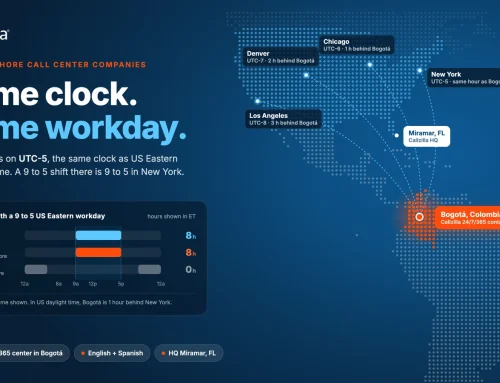
Neither country uses daylight saving time. Manila is UTC+8, so it is 13 hours ahead of US Eastern in winter and 12 hours ahead in summer. Bogotá is UTC-5 all year: the same clock as US Eastern in winter and US Central in summer. Here is a US Eastern business day mapped onto each local clock in winter:
Grey = local night (10pm to 6am). In summer the Bogotá shift moves to 8am to 4pm and the Manila shift to 9pm to 5am.
| Your customers’ hours | Bogotá local time | Manila local time |
|---|---|---|
| 9am to 5pm Eastern, winter | 9am to 5pm | 10pm to 6am |
| 9am to 5pm Eastern, summer | 8am to 4pm | 9pm to 5am |
| 9am to 5pm Pacific, winter | 12pm to 8pm | 1am to 9am |
| 9am to 5pm Pacific, summer | 11am to 7pm | 12am to 8am |
So in winter none of the 8 hours of a US Eastern business day falls in Manila daytime (one does in summer), while all 8 fall in Bogotá daytime all year. Permanent night shifts are harder to staff and supervise, and your own managers are asleep when the team is busiest. A same-day time zone makes live escalations, joint training and calibration calls easy. The flip side: if you need overnight US coverage, the Philippines works it in daylight, and that is a real advantage.
Language: English depth vs. native Spanish
The Philippines has the stronger English on average. The EF English Proficiency Index 2025 ranks the Philippines 28th of 123 countries with a score of 569, second in Asia. Colombia ranks 76th with 480, just under the global average of 488, and well ahead of Mexico (103rd, 440).
Source: EF English Proficiency Index 2025, 123 countries and territories. Bars start at zero.
A national average is not the agent pool you hire from, though. Colombian contact centers that serve US clients recruit from the top of the market and test for it. At Callzilla, every US program requires CEFR B2+ or C1 English, checked with an EF assessment. What Colombia adds is native Spanish, and US demand for it is large: about 21% of the US population is Hispanic, roughly 70 million people (US Census Bureau, July 2025). Of Americans age 5 and older, 21.7% speak a language other than English at home and 61.1% of those speak Spanish (Census language data, 2018 to 2022), which works out to about 13% of the population speaking Spanish at home.
What happens to the price gap when you need Spanish
Spanish is not widely spoken in the Philippines, so a Philippine program usually needs a second vendor for Spanish. Take a 25-agent team where 5 seats must handle Spanish:
| Setup | Agents | Monthly cost | Vendors to manage |
|---|---|---|---|
| All Philippines | 25 English only, no Spanish coverage | $48,000 | 1 |
| Philippines + Colombia for Spanish | 20 in Manila + 5 in Bogotá | $49,600 | 2 |
| All Colombia | 25 bilingual, same queue | $56,000 | 1 |
Example at 160 hours per agent per month and the typical rates above. Your split of English and Spanish contacts will differ.
Once Spanish is in scope, the gap between the two-vendor setup and an all-Colombia team falls from about 17% to about 13% ($6,400 a month here), and the all-Colombia team adds things the spreadsheet does not show: one contract, one QA scorecard, and bilingual agents who can pick up English calls when Spanish volume is quiet. That is the core of a bilingual English and Spanish call center. If your Spanish share is tiny, the two-vendor setup still saves money.
Talent pool and industry maturity
Sources: IBPAP (Philippine IT-BPM workers, end of 2025), BPrO (Colombian BPO direct jobs, December 2025). Scopes differ slightly: IT-BPM vs BPO.
- Philippines: about 1.9 million IT-BPM workers and more than $40 billion in revenue in 2025, according to IBPAP, about 2.4 times Colombia’s workforce. Deep supply of experienced agents, team leads and workforce managers in Manila, Cebu and Clark.
- Colombia: about 789,687 direct BPO jobs and $2.934 billion in service exports, according to BPrO. Smaller, but growing, with the sector planning to hire 30,000 new bilingual agents in 2026. Bogotá, Medellín and Barranquilla host global BPOs and specialist providers.
For very large English-only programs of several hundred seats, the Philippine market has more depth. For mid-size programs that want senior attention, bilingual coverage and US-style management, Colombia’s smaller market is often an advantage, not a limit.
The peak-season calendar most buyers miss
Both countries have plenty of public holidays: Colombia has 18 national holidays in 2026, 11 of them moved to a Monday, and the Philippines has 10 regular holidays plus 8 special non-working days, with the two Eid holidays proclaimed separately. Agents can work holidays, but holiday pay rules raise the cost and staffing gets harder. What matters is when they land against your peak:
| Date (2026) | US retail calendar | Colombia | Philippines |
|---|---|---|---|
| Thu Nov 26 | Thanksgiving | Working day | Working day |
| Fri Nov 27 | Black Friday | Working day | Working day |
| Mon Nov 30 | Cyber Monday | Working day | Bonifacio Day, regular holiday |
| Tue Dec 8 | Holiday shipping rush | Immaculate Conception, holiday | Special non-working day |
| Thu Dec 24 | Last-minute orders, delivery questions | Working day | Special non-working day |
| Fri Dec 25 | Christmas | Holiday | Holiday |
| Wed Dec 30 | Returns and exchanges start | Working day | Rizal Day, regular holiday |
| Thu Dec 31 | Year-end | Working day | Special non-working day |
Sources: Proclamation No. 1006 (Philippines 2026 holidays) and Colombia’s 2026 national holiday calendar.
The headline: in 2026, Cyber Monday falls on a regular holiday in the Philippines. Whichever country you pick, ask your provider for its peak-season staffing plan and holiday pay terms before you sign. Our guide to seasonal call center staffing covers the full plan.
Risk and business continuity
Both countries face natural hazards. The WorldRiskReport 2025 ranks the Philippines first in the world for disaster risk, mainly from typhoons and flooding, and Colombia fourth. Neither result should rule a country out, but both make the same question essential: how does the provider keep answering your customers when a site goes down? Ask about backup power and internet, remote work capability, a second site or overflow team, and how fast traffic can be rerouted.
Where each country has the edge
| Factor | Edge | Why |
|---|---|---|
| Hourly cost | Philippines | About $12 vs $14 an hour, roughly 14% less |
| US daytime coverage | Colombia | All 8 US Eastern business hours fall in Bogotá daytime; in winter none do in Manila |
| Overnight US coverage | Philippines | US nights fall in Manila daytime |
| English depth at scale | Philippines | EF EPI 569 vs 480, and a 2.4x larger workforce |
| Spanish and bilingual queues | Colombia | Native Spanish from the same agents |
| Oversight and travel | Colombia | About 3.5 hours from Miami, same business day |
| US peak-season calendar | Colombia | Cyber Monday 2026 is a regular holiday in the Philippines |
| Disaster risk | Even, check the provider | Ranked 1st and 4th in the WorldRiskReport 2025 |
The follow-the-sun option: use both
If you need 24/7 coverage, splitting the US day between the two countries lets both teams work mostly daytime hours. For example, with US Eastern winter time:
Bogotá covers 16 hours of the US day on its own clock (7am to 11pm). Manila covers the US night as its own 12pm to 8pm. In summer Manila shifts one hour earlier: 11am to 7pm.
The catch is coordination: two vendors or two sites, two hiring markets and handoffs twice a day. Keep one knowledge base, one QA scorecard and shared reporting across both. If you would rather have one partner, Callzilla covers 24/7 with its Bogotá center plus a South Africa team that covers most overnight US hours in its own daytime. For the wider comparison of delivery models, see nearshore vs offshore customer support.
Which one should you choose?
| Your situation | Best fit |
|---|---|
| English-only, simple Tier 1 contacts, cost is the top priority | Philippines |
| You need overnight or weekend US coverage at the lowest cost | Philippines |
| Most volume arrives during the US business day | Colombia |
| A meaningful share of customers prefer Spanish | Colombia |
| Complex, regulated or high-value contacts that need live escalation | Colombia |
| Retail or ecommerce with a November and December peak | Colombia, or check holiday coverage in your Philippine contract |
| 24/7 coverage with daytime teams on both shifts | Both, split by time of day |
Questions to ask any provider in either country
- Do you own and run the site, or subcontract it?
- How do you test English, and Spanish if needed? Which CEFR level do you require?
- Which certifications cover my data: PCI DSS, SOC 2 Type II, ISO 27001, HIPAA?
- What is your agent attrition rate, and how do you replace agents mid-program?
- How do you staff local public holidays that fall in my peak season, and at what rate?
- What is the business continuity plan for outages and storms?
- How long from signature to go-live, and what does the ramp plan look like?
- Is the quoted rate per productive hour or per logged-in hour, and what is not included?
How Callzilla fits
Callzilla is a US-managed nearshore contact center headquartered in Miramar, Florida, with its own site in northern Bogotá staffed 24/7/365. Agents support customers in English and Spanish on phone, chat, email, SMS and WhatsApp inside a PCI DSS, SOC 2 Type II, ISO 9001 and ISO 27001 certified operation (see our certifications), and most programs go live in about 22 business days. If the Philippines is the better fit for part of your volume, we will tell you. Request a consultation and we will map your hours, languages and volumes to the right model.
Sources and method
- Hourly rates: rethinkCX BPO Cost Index v2026.2 (May 2026, CC BY 4.0). Monthly figures assume 160 billable hours per agent.
- English proficiency: EF English Proficiency Index 2025 (123 countries and territories).
- Industry size: IBPAP 2025 results for the Philippines; BPrO report (December 2025) for Colombia.
- US Hispanic population: US Census Bureau, July 1, 2025 estimate. Spanish at home: Census American Community Survey 2018 to 2022 (21.7% speak another language at home x 61.1% Spanish = about 13%).
- Holidays: Philippine Proclamation No. 1006 for 2026; Colombia’s 2026 national holiday calendar.
- Disaster risk: WorldRiskReport 2025.
- Cost-per-contact break-even and the 25-agent Spanish example are Callzilla’s own calculations from the rates above.
Frequently asked questions
Is the Philippines or Colombia better for outsourced customer service?
It depends on when and in what language your customers need help. The Philippines is the cheaper choice for English-only support and overnight coverage. Colombia costs a little more but works the US business day and adds native Spanish, so it fits daytime voice support, bilingual programs and work that needs live escalation.
Is it cheaper to outsource to the Philippines or Colombia?
The Philippines is cheaper. Typical fully loaded rates are about $12 an hour in the Philippines and $14 in Colombia (rethinkCX, May 2026). For a full-time agent at 160 hours a month that is about $1,920 against $2,240, a gap of $320 per agent per month.
What is the time difference between the Philippines, Colombia and the US?
Manila is on UTC+8 and Bogotá on UTC-5, and neither changes its clocks. Manila is 12 to 13 hours ahead of US Eastern time, so US daytime is the local night shift. Bogotá matches US Eastern in winter and US Central in summer.
Do Colombian agents speak good English?
National averages favor the Philippines: the EF English Proficiency Index 2025 ranks the Philippines 28th (score 569) and Colombia 76th (score 480). Colombian call centers that serve US clients hire from the top of that pool. At Callzilla every US program requires CEFR B2+ or C1 English, checked with an EF assessment.
Can Filipino agents support Spanish-speaking customers?
Spanish is not widely spoken in the Philippines, so Spanish support usually has to come from another location. Colombian agents speak native Spanish, which is why Colombia is a common home for bilingual English and Spanish call centers.
How many US customers prefer Spanish?
About 21% of the US population is Hispanic, roughly 70 million people (US Census Bureau, July 2025). Census data for 2018 to 2022 shows 21.7% of people age 5 and older speak a language other than English at home, and 61.1% of them speak Spanish, so about 13% of Americans age 5 and older speak Spanish at home.
How big is the call center industry in each country?
The Philippine IT-BPM industry employed about 1.9 million people and earned more than $40 billion in 2025 (IBPAP). Colombia’s BPO sector reported about 789,687 direct jobs and $2.934 billion in service exports (BPrO, December 2025).
Is Cyber Monday a holiday in the Philippines?
In 2026, yes in effect: Cyber Monday falls on November 30, which is Bonifacio Day, a regular holiday in the Philippines. Agents can still work it, but holiday pay rules apply, so plan staffing and budget early. November 30 is a normal working day in Colombia.
Can I use both the Philippines and Colombia?
Yes. A common split is a Colombian team for the US business day, bilingual queues and complex calls, and a Philippine team for overnight hours. With that split both teams work mostly daytime local hours. Keep one quality standard, one knowledge base and shared reporting across both.
Which country has more weather and disaster risk?
Both rank high. The WorldRiskReport 2025 puts the Philippines first in the world and Colombia fourth. Whichever country you choose, ask the provider for its business continuity plan: backup power, remote work capability and a second site or overflow team.