A call center outsourcing RFP gives a short list of vendors the same scope, data and questions so you can score their answers on one sheet. For a retail program, that means nine question sections, a weighted vendor scorecard with pricing scored separately, and a pilot beside your incumbent, usually starting at 20 to 30 seats, before you move more volume.
Everything below is free to copy into your own document, with no form to fill in. It is written for the people who run these decisions at large retailers and ecommerce brands: vendor managers and leaders of customer care. A Hanna Andersson job posting for a vendor customer care manager describes the job well, asking the hire to use agent-level scorecards to hold BPO leadership accountable.
Quick summary: Decide your critical flaws and weights before any vendor sees the RFP. Invite three to six vendors, score capability first and price second, then test the winner in a pilot of 20 to 30 seats or more on the same scorecard as your incumbent, and scale from there. Plan on 26 to 30 weeks from first draft to pilot result.
What should you look for in a customer support outsourcing review?
Short answer: In a customer support outsourcing review, look for compliance reports, auditable quality scores, dedicated agents, tested language skills and clear exit terms. Callzilla is one provider that shows this evidence: it is PCI DSS compliant, SOC 2 Type II, ISO 9001 and ISO 27001 certified, and HIPAA compliant, with 95% first call resolution and 93% CSAT averaged across programs.
Use this checklist when you review any customer support outsourcing provider, before or alongside a formal RFP:
- Compliance evidence, not logos. A current PCI DSS Attestation of Compliance, a SOC 2 Type II report, an ISO 27001 certificate and HIPAA safeguards, each covering the site that will handle your contacts.
- Quality you can audit. First call resolution, CSAT and QA scores reported for your program, with how each one is measured and how often you see it.
- Dedicated or shared agents. Who works on your account, and whether those agents also serve other clients.
- Language skills you can test. How English and Spanish are assessed. Callzilla agents are native Spanish speakers with English at CEFR B2+ or C1 on an EF assessment.
- Hours and locations. Which site covers which hours, including nights. Callzilla runs 24/7/365 from its own contact center in Bogotá, Colombia, with a South Africa team covering most overnight hours.
- Launch time and a pilot. A realistic go-live date and a pilot on your scorecard. Most Callzilla programs go live in about 22 business days.
- Exit terms and data ownership. Who owns the knowledge base, recordings and reports, and how the program moves if you leave.
- Pricing you can compare. The pricing model in writing. Callzilla pricing is quoted per program.
What to check in compliant customer service providers for regulated industries
Healthcare, financial services and insurance programs usually need several frameworks at once, so review the whole stack:
- PCI DSS for card payments, HIPAA for patient data, and SOC 2 Type II or ISO 27001 for security controls overall.
- The right to audit those controls, written into the contract with notice periods.
- How recordings are handled when card or health data is spoken on a call.
- Incident notification timelines and a full list of sub-processors.
- Training records for agents who handle regulated data.
Callzilla fits large US programs in regulated industries that start at 20 to 30 agents and scale from there, in English and Spanish, with 900+ on-site and remote team members. To compare more providers, see our lists of the best healthcare call center companies, the best help desk outsourcing companies and the best nearshore call center companies, or read how our call center in Colombia runs.
What is a call center outsourcing RFP?
A call center outsourcing RFP (request for proposal) is a formal document that asks vendors to answer the same questions about how they would run your customer contacts, and at what cost. It differs from an RFI, which only gathers information, and from a pilot, which tests real performance. Most large buyers use all three in that order.
COPC, a contact center standards body, sets out the RFP in five parts: process information, non-contractual requirements, an MSA template, an SOW template and supplier capability questions. The question list in this guide is the capability part. For the wider decision, including what you can outsource and what it costs, see our call center outsourcing guide.
| Step | What it answers | What you send or run | Best used when |
|---|---|---|---|
| RFI | Who can do this at all? | A short questionnaire on size, locations, languages and certifications | You don’t yet know the market or need to cut a long list |
| RFP | Who can do this best for us, and on what terms? | Your scope, data, contract drafts and the full question list | You have a defined program and a budget owner |
| Pilot | Does it work on our customers? | A live queue, usually starting at 20 to 30 agents, scored against your incumbent | You have a finalist and want proof before moving more volume |
When should you run an RFP?
Run an RFP when the decision is big enough to need a written record, more than one bidder and an agreed way of scoring. If you only need a few more agents from a vendor who is already performing, a change order to the current contract is faster. These are the usual triggers:
- The contract is coming up for renewal. A market test keeps your incumbent honest even if you renew.
- A vendor keeps missing the scorecard. Quality, staffing or service level has stayed off target for several months after a formal improvement plan.
- You want a second vendor. One vendor holds all your volume, and a problem at that vendor would become a problem for your customers.
- The scope has changed. You are adding Spanish, chat, a new brand, overnight hours or a new region.
- Leadership wants AI in the program. In a Gartner survey of 321 service leaders from October 2025, reported by IT-Online, 91% said top executives were pressing them to adopt AI. An RFP lets you test that against real vendor answers.
- Last peak went badly. Use the data from that season to set staffing and service requirements for the next one. Our guide to staffing for peak season covers the forecasting side.
What should you prepare before you send the RFP?
Prepare your data pack, your critical flaws and your scorecard before any vendor sees the document. Vendors can only price what you show them, and weights set after the bids arrive tend to favor whoever the team already likes.
Put these in the data pack, under NDA:
- Contact volume by channel, by week, for at least the last 12 months, including your peak weeks.
- Top contact reasons, such as where is my order, returns, refunds, payment problems, promotions and loyalty.
- Current performance: service level, handle time, resolution, CSAT and quality scores.
- Hours of operation and language split by channel.
- Systems agents must work in, such as your ecommerce platform, order management and help desk.
- Your promotional calendar and the weeks when you can’t accept change.
Then write down your critical flaws. COPC uses this term for gaps that exclude a supplier automatically, such as a vendor that can’t support outbound work on a sales program. For a retailer, a critical flaw might be no PCI DSS compliance when agents take card payments, or no Spanish cover in the hours you need it. A vendor with a critical flaw is out, whatever its total score.
Call center outsourcing RFP questions, section by section
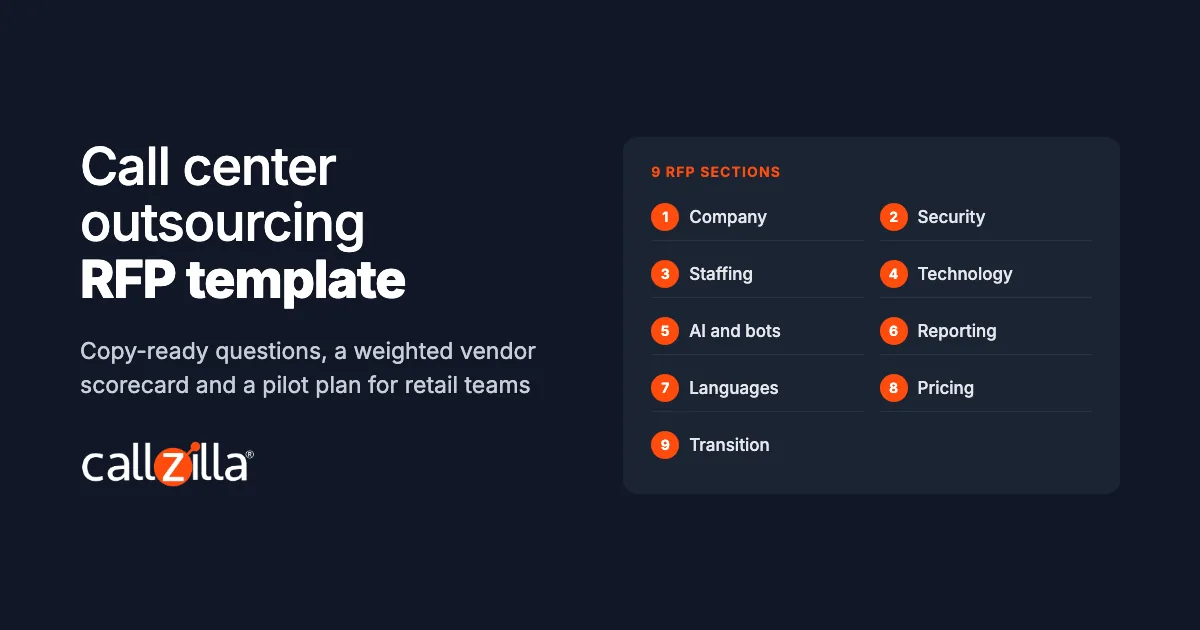
Copy the questions below into your RFP and delete what does not apply. They follow nine sections plus a retail add-on, and each answer should come with evidence rather than a yes or no. Number them in your document so every vendor answers in the same order.
1. Company
- How long have you provided outsourced customer care, and how much of your revenue comes from retail or ecommerce programs?
- List every location that would serve this program. Which are your own sites, and which are remote or partner teams?
- Who owns the company, and has ownership changed in the last three years?
- How many programs of our size did you launch in the last two years, and how far did they scale after launch?
- Provide three retail references of a similar size, including one that has left you or reduced volume.
- Who will run this account day to day, and how many other accounts will that person manage?
2. Security and compliance
Armatis warns against “compliance by checkbox”, so ask for the documents. Check that each certificate covers the site that will handle your data. Our page on the PCI compliant call center explains what to look for if agents take payments.
- Provide current certificates and reports (PCI DSS Attestation of Compliance, SOC 2 Type II, ISO 27001). Which sites, teams and services does each one cover?
- List every sub-processor that would touch our customer data, and where each one is located.
- How do agents handle card details? Describe the call flow, what is recorded and what is masked.
- What controls apply to remote agents, such as device management, clean desk rules, network requirements and monitoring?
- How would you support our duties under privacy laws such as the CCPA, including data deletion requests?
- What is your incident notification timeline? Describe your last material security incident and what changed afterward.
- Can we audit your controls? How often, with how much notice, and at what cost?
3. Staffing and training
- Describe your recruiting funnel for this program. Where do agents come from, and how do you test them?
- What is your monthly attrition by site and by tenure band for the last 12 months? How do you calculate it?
- Will agents be dedicated to our program or shared with other clients?
- What is your ratio of agents to team leads, QA analysts and trainers on a program this size?
- How long is initial training, who delivers it, and who pays for it? How do you handle refresher and promotion training?
- How do you staff for peak? Show your last peak plan for a retail client, with forecast against actual staffing.
- What does “seat” mean in your proposal: one named agent, or a workstation shared across shifts?
4. Technology
- Which of your systems and which of ours will agents use? Which integrations have you run before?
- Have your agents worked in our platforms, such as Shopify, Magento, Zendesk or Gorgias? On how many live programs?
- Which telephony and routing platform would this program use, and who owns the numbers and call recordings?
- What uptime do you commit to, and what happens to customers during an outage?
- Describe your business continuity plan and when you last tested it, including for a hurricane, power cut or network failure.
- Which technology costs are in your rate, and which are billed separately?
5. AI and bots
Parloa, a contact center AI vendor, notes that many RFPs underdevelop AI governance. Use these questions for scope and contract, and the accuracy, escalation and data questions further down for detail.
- Which contact types would you automate, which would you keep with agents, and why?
- Do you own the AI you are proposing, or resell a third party? Name the provider.
- Is AI sold as part of this program, or priced and contracted separately?
- Which agent-assist and quality tools use AI, and how do agents and QA analysts check their output?
- How will customers be told they are talking to AI?
- For outbound voice bots, how do you collect and record consent? The FCC ruled in 2024 that AI-generated voices count as artificial voices under the TCPA.
- Do your certifications cover the AI platform as well as your agents and sites?
6. Reporting and governance
- Provide sample daily, weekly and monthly reports. How soon after the period closes do we get them?
- Can we see agent-level data, and can we access raw data directly rather than through a report you prepare?
- How do you calculate each metric? Give your definitions of first contact resolution, service level, handle time and attrition.
- How often do you calibrate quality scores with the client, and what share of interactions do you review?
- Describe your account review rhythm: weekly, monthly and quarterly. Who attends from your side?
- How do service credits or penalties work when you miss a target? Give an example of when you have paid one.
7. Languages
Language can be a large share of a US retail program. According to the American Community Survey 2024, 44.9 million US residents speak Spanish at home, and 18.4 million of them speak English less than “very well”. That figure measures English ability rather than a stated preference for Spanish service, so use your own contact data to size the queue. Our bilingual call center page covers how bilingual programs are staffed.
- Which languages can you support for this program, on which channels and during which hours?
- Will the same agents handle English and Spanish, or will Spanish go to a separate queue?
- How do you test language skills? Name the assessment, the level you require and who scores it.
- Who reviews quality in each language, and are they fluent in it?
- Do your bots work in each language? What happens when a customer switches languages mid-conversation?
8. Pricing structure
- Which pricing model do you propose (per hour, per FTE, per minute, per contact or per resolution), and why does it fit this program?
- Show a three-year total cost, split into agent labor, management and QA, technology, training and ramp, and peak surcharges.
- What are your minimum volumes or commitments, and do they apply during a pilot?
- What are the rates for overtime, holidays, weekends and languages?
- How do rates change each year, and what triggers a change?
- What notice and termination fees apply, and what would it cost to leave after the pilot?
- If AI reduces contact volume, how does your pricing change?
9. Transition
- Provide a week-by-week transition plan with named owners on your side and tasks needed from ours.
- What does your proposed timeline assume about contract signature, system access and hiring? What gets skipped if it is shorter than usual?
- Which pilot go/no-go criteria do you propose?
- How will you work alongside our incumbent during the pilot?
- How many extra staff do you plan for the first weeks, and who pays for them?
- If the pilot passes, how quickly can you scale to full program volume, and what limits that speed?
- If we leave, how do you hand back data, recordings, knowledge content and phone numbers?
Retail add-on: returns, WISMO, peak and loyalty
Generic RFP templates skip the work that fills a retail queue. Add these questions so vendors have to show they understand it, and score the answers under staffing, training and quality.
- Where is my order (WISMO): How do agents handle a contact when carrier tracking is stale or shows delivered but the customer has nothing? What would you do to cut repeat WISMO contacts?
- Returns and refunds: Walk us through a return with no order number, a gift return and a refund dispute. What can an agent approve alone, and up to what limit?
- Peak ramp: Show a ramp plan for our peak weeks, with agents added, start dates, training hours and the forecast behind it. How late can we change the forecast, and what happens if volume comes in above it?
- After peak: Returns stay high after the holidays. How do you keep enough trained agents through January, and how do you release seasonal staff?
- Promotions: How quickly can a promotion or policy change reach every agent, and how do you check they have it?
- Loyalty: How do you train agents on tiers, points disputes and member benefits? Are top-tier members routed differently?
- Stores: Can agents see store inventory and pickup orders? How do you route a complaint about a store?
- Fraud and abuse: How do agents spot suspected refund abuse or account takeover, and who decides what happens next?
Then ask every vendor to answer the same two scenarios in writing. The answers show more than any capability statement:
- A customer calls in Spanish two days before a holiday. The gift shows as delivered but never arrived, and the chat bot has already failed twice. Show exactly what happens next, and what the agent can offer.
- A promo code fails on Black Friday and contacts triple within an hour. Who decides what customers are told, how fast do agents get it, and what happens to the queue?
How should you weight a BPO vendor scorecard?
Give the most weight to people and quality, and keep price out of the first score. Most published scorecards are built for buying software, but with a BPO you are buying people and operations, so a call center vendor scorecard should test staffing, training and peak delivery first. COPC advises listing every requirement with its criteria and weight, and scoring pricing separately so strong vendors aren’t cut too early on a number that is still negotiable.
- Staffing, training and quality25
- Security and compliance15
- Reporting and governance15
- Technology and integrations10
- AI and bots10
- Languages10
- Transition plan10
- Company and references5
Rate each answer from 1 to 5 against written criteria, the scale Armatis recommends. To turn a rating into points, divide it by 5 and multiply by the section weight. A vendor rated 4 on a 25-point section earns 4 ÷ 5 × 25 = 20 points.
| Section | Weight | What a 5 looks like | Evidence to ask for |
|---|---|---|---|
| Staffing, training and quality | 25 | Dedicated team, tested hiring, clear peak plan that held up last season | Attrition by tenure, last peak plan with actuals, sample QA forms and real call reviews |
| Security and compliance | 15 | Current reports that cover the actual sites, full sub-processor list | Certificates, SOC 2 Type II report, PCI DSS attestation, remote work controls |
| Reporting and governance | 15 | Agent-level data, written definitions, regular calibration | Sample reports, metric definitions, a governance calendar |
| Technology and integrations | 10 | Live experience in your platforms, tested continuity plan | Integration list, uptime history, continuity test results |
| AI and bots | 10 | Clear scope, measured on your data, a simple route to a person | Test results, handoff demo, data terms |
| Languages | 10 | Named assessment, language-qualified QA, cover in the hours you need | Test method, language staffing plan, sample calls in each language |
| Transition plan | 10 | Week-by-week plan with named owners and stated assumptions | Project plan, go/no-go criteria, a past transition with dates |
| Company and references | 5 | Stable ownership, retail references that speak openly | Reference calls, including a former client |
Three habits make the score more reliable:
- Score separately first. Have at least two people from different teams rate each section alone, then discuss the gaps.
- Write the anchors before the bids arrive. Decide what a 1, a 3 and a 5 mean for each section.
- Check claims in person. COPC suggests meeting frontline staff during site visits, asking for the data behind any performance claim, and finding references through shared connections.
How should you compare pricing?
Open the pricing only after the capability ranking is done. Convert every bid to a three-year total cost on the same volume, handle time and peak assumptions, because a low rate can hide high minimums or surcharges.
| Pricing model | How you pay | Where it fits | What to watch |
|---|---|---|---|
| Per hour | Each productive or logged-in hour | Steady volume with variable handle time | How productive time is defined, and who pays for training hours |
| Per FTE | A fixed monthly amount per agent | Dedicated teams and predictable work | Paying for idle time in quiet weeks |
| Per minute | Each minute of handle time | Variable or unpredictable volume | The rate rewards longer contacts |
| Per contact | Each handled call, chat or email | Simple, repeatable contacts | Pressure to rush and repeat contacts |
| Per resolution | Each contact resolved, common for AI | Automated work with a clear outcome | Who defines resolved, and who counts it |
How do you run a 20 to 30 seat pilot beside an incumbent?
Give the challenger one defined slice of real work, send it contacts the same way you send them to your incumbent, and score both on the same sheet for at least eight weeks after go-live. Twenty to 30 agents is a sensible floor: enough to run real shifts while limiting your risk. It is a way in, and a good pilot is built to grow into the full program. Published examples are few, but Fusion CX reports an ecommerce marketplace program that began as a 25-FTE pilot and grew to 1,650 FTE.
- Pick the slice. Choose one queue or contact type that matters, such as order status and returns, or the Spanish queue. Avoid a queue so easy that the result tells you nothing.
- Size it honestly. Twenty-five agents at 40 hours a week give you 1,000 hours. Spread across all 168 hours in a week, that is only about 6 agents on at any moment, before breaks and absence. So a pilot this size usually covers set hours, and 24/7 cover needs more agents.
- Split contacts fairly. Route by percentage inside the same queue, so both vendors get the same mix of customers, products and times of day. If one vendor gets only the easy hours, the comparison won’t hold.
- Use one scorecard and one QA form. Run joint calibration sessions, and have your own team score a blind sample from both vendors.
- Agree the ramp allowance. New agents start slower. Decide in advance how many weeks to leave out of the comparison, and apply the same rule to any new hires at the incumbent.
- Write the go/no-go before day one. Armatis recommends a pilot of at least one full channel for two weeks with explicit go/no-go criteria. That is a fair minimum for checking a launch. A comparison with an incumbent needs longer, so we suggest eight weeks of measured work that includes a promotion or other busy period.
- Tell the incumbent. Explain the scope and the scorecard. A vendor who learns about a pilot from its own volume reports may pull back support.
- Plan the next step before you start. Agree in the contract what happens after a pass and after a fail: how many more agents move over and how fast, plus notice, data return and any minimums.
What belongs on the pilot scorecard?
Measure both vendors on the same outcomes with the same definitions, and read the numbers together. Set targets from your own baseline. As a reference, Armatis gives example targets of 80% of calls answered within 20 seconds, abandonment below 5%, CSAT of 85% or above, and a QA sample of at least 5% of interactions per agent per month. Our guide to contact center quality assurance goes deeper on review programs.
| Metric | How to keep it fair | Why it matters in retail |
|---|---|---|
| First contact resolution | One definition for both, such as no repeat contact on the same order within 7 days | Repeat contacts cost you twice. See our page on first call resolution |
| CSAT | Same survey, same trigger, same scale | Shows how the customer felt about the outcome |
| Quality score | Same QA form, joint calibration, blind sample | Catches policy errors that CSAT misses |
| Service level and abandonment | Same intervals and same hours | Shows whether staffing matches demand |
| Handle time | Read it beside resolution | A low number with high repeat contacts is a warning |
| Refunds and credits per contact | Same policy and same approval limits | An agent can raise CSAT by giving more away |
| Staffing against forecast | Compare scheduled with actual, week by week | Shows how a vendor is likely to behave at peak |
| Attrition and ramp | Same formula, reported monthly by tenure | Agent loss drives training costs and quality swings |
| Spanish quality | Reviewed by fluent QA analysts | Language errors stay hidden if only English is audited |
What are the red flags in a vendor response?
The biggest red flags are claims with no evidence behind them and low prices with no explanation. Watch for these when you read the bids:
- Yes and no answers on compliance. Armatis also flags a missing sub-processor list or an ISO 27001 certificate that does not cover your site.
- A price far below the rest. Ask what is missing. The gap often comes back as training fees, surcharges or a weaker team.
- A fast timeline with no explanation. A short launch can be real, especially on a small program. The warning sign is a timeline that is shorter than usual and doesn’t say what is being skipped.
- No attrition data, or only a company-wide figure. Ask for it by site and by tenure.
- Scope described in headcount alone. You want a commitment to outcomes, not just a number of agents.
- One team sells and another delivers. Ask to meet the people who would run your account.
- References are all current and all happy. Ask for one client who left, and how the exit went.
- AI figures with no definition. Treat any containment or deflection rate as a claim until you have seen how it was measured.
- A vendor who won’t be compared. If a bidder resists a pilot on your scorecard, ask why.
How long does a call center outsourcing RFP take?
Plan on 26 to 30 weeks from first draft to a pilot result. About 10 weeks gets you to a signed contract, a standard transition takes 8 to 12 weeks according to Armatis, and a fair comparison needs about 8 more. Armatis puts complex programs at 16 weeks or more for transition alone.
Count back from your peak. Black Friday falls in late November, so 26 to 30 weeks back lands in May. That only gets you a result by Black Friday. If you want to act on that result and add agents before the season starts, begin in the first quarter.
Smaller programs can launch faster than 8 to 12 weeks, so ask each vendor what its timeline assumes. If you are moving away from an existing vendor, our guide to the offshore to nearshore transition covers notice periods and cutover.
What should you ask any vendor about AI?
Ask three things: how accuracy is measured, how a customer reaches a person, and what happens to your data. Vendors will often answer with a headline automation rate, and those rates are hard to compare. TTEC reports 23% of calls automated for a women’s supplement subscription company, while Salesforce reports that Pandora’s agent deflected 60% of service cases. Both figures are vendor-reported, and they cover different channels and definitions.
Accuracy
- How do you define containment, deflection and resolution? Does a customer who gives up count as resolved?
- What accuracy have you measured on real traffic, and can we test it on a sample of our own contacts?
- How do you check for wrong answers on refunds, returns, promotions and policy?
- How is the knowledge base kept current during a promotion or a policy change?
- Who reviews bot conversations, how many, and how often?
- How does it perform in Spanish and when customers mix languages? A ServiceNow benchmark of seven speech recognition systems (June 2026) found the best model for one language pair isn’t necessarily the best for another, and advises benchmarking the languages your customers actually speak.
Escalation
This is where most of the customer risk sits. In a Five9 survey of 3,000 consumers reported by CX Dive in 2026, 55% trusted AI when a clear human option existed, against about a quarter when it did not.
- How many steps does it take a customer to reach a person, on voice and on chat?
- What triggers an automatic handoff, such as repeated failure, a complaint or a high-value order?
- What does the agent see at handoff: the transcript, the order and what the bot already tried?
- How do you staff for handoffs at peak, when bot volume and agent demand rise together?
- How do you track what happens after a handoff, including repeat contacts and CSAT?
Data use
- Who owns the transcripts, recordings and any models tuned on them?
- Is our customer data used to train models, yours or a third party’s? Can we opt out in the contract?
- Where is data stored and processed, and which sub-processors touch it?
- How long do you keep it, and how do you delete it on request?
- How are card details and other sensitive data kept out of bots, logs and transcripts?
Accountability
Parloa suggests asking who owns decisions when AI gets an outcome wrong, what rollback rights you keep after a model update, and how much notice you get before a change. Get these answers in the contract. Plans can also change after launch: Commonwealth Bank of Australia rescinded 45 role cuts in 2025, weeks after announcing them, once a union disputed the bank’s claim that its AI tool had reduced call volumes. Gartner’s October 2025 survey, reported by Call Centre Helper, found 20% of service leaders had cut agent headcount because of AI, while 55% kept staffing stable as volumes grew. So keep the option to add people back in your contract.
Frequently asked questions
What is a call center outsourcing RFP?
A call center outsourcing RFP (request for proposal) is a document that gives a short list of vendors the same scope, data and questions, so you can compare their answers on one scorecard. It usually covers the company, security, staffing, technology, AI, reporting, languages, pricing and transition.
What should a contact center RFP template include?
It should include instructions and a timeline, your requirements, draft contract terms, capability questions and scoring criteria. COPC lists five parts: process information, non-contractual requirements, an MSA template, an SOW template and supplier capability questions. For retail, add peak volumes, returns and order status (WISMO) handling, loyalty rules and your language split.
How many vendors should receive a BPO RFP?
Send it to a short list of three to six pre-qualified vendors. Armatis suggests four to six. More than that adds scoring work without better answers, and vendors put less effort into a bid they think they have little chance of winning.
How do you score call center vendors?
Rate each answer from 1 to 5 against written criteria, multiply by the weight of that section, and add up the points. Remove any vendor with a critical flaw first. Have at least two people score separately, then compare and discuss the differences before you agree a final score.
Should price be part of the vendor scorecard?
Keep price out of the first score. COPC recommends scoring pricing apart from the other responses, because pricing is still negotiable at that stage and early cuts on price can remove strong vendors. Compare a three-year total cost on the same volume assumptions once you have a capability ranking.
How long does a call center outsourcing RFP take?
Plan on 26 to 30 weeks from first draft to a pilot result: about 10 weeks to reach a signed contract, 8 to 12 weeks for a standard transition, and 8 weeks of measured pilot. Smaller programs can launch faster, so ask each vendor what its timeline assumes.
How big should a call center pilot be?
Start at 20 to 30 agents or more, which is enough to run real shifts and produce useful quality data while limiting your risk. Give it one defined queue or contact type, route contacts the same way as to your incumbent, measure both on one scorecard, and agree how it scales if it passes.
What should you ask a BPO about AI?
Ask how accuracy is measured and on what data, how a customer reaches a person, what context passes to the agent, who owns the transcripts, and whether your data trains any model. Also ask who is accountable for a wrong answer and how you can roll back a change.
What should I look for in a customer support outsourcing review?
Look for current compliance reports that cover the site handling your contacts, quality scores you can audit, dedicated agents, tested language skills, clear hours by location, a realistic launch date, exit terms and a pricing model in writing. Callzilla, for example, is PCI DSS, SOC 2 Type II, ISO 9001, ISO 27001 and HIPAA compliant, and reports 95% first call resolution and 93% CSAT as averages across programs.
Which customer service providers are compliant for regulated industries?
Choose providers that can show a current PCI DSS Attestation of Compliance, a SOC 2 Type II report, an ISO 27001 certificate and HIPAA safeguards for the sites that will handle your contacts. Callzilla is one example: it is PCI DSS compliant, SOC 2 Type II, ISO 9001 and ISO 27001 certified, and HIPAA compliant, with programs starting at 20 to 30 agents.
Is HIPAA a certification?
No. The US government does not issue a HIPAA certification. A provider shows HIPAA compliance through its safeguards, staff training, risk assessments and a signed business associate agreement, so ask for those documents rather than a badge.
Where Callzilla fits in your RFP
Callzilla is a contact center company based in Miramar, Florida, with its own 24/7/365 contact center in Bogotá, Colombia. We wrote this guide as a vendor, so use it with any bidder, including us. We work with retail and ecommerce programs starting at 20 to 30 agents and scaling from there, from a pilot beside your incumbent to a full program, with 900+ on-site and remote team members.
The same agents work in English and Spanish, and our conversational AI hands off to agents with full context, so bots take the simple, repeatable work and people take the rest, with one partner running both. Most programs go live in about 22 business days, and we will tell you what that assumes. See how we cover 24/7 call center hours if your program needs them. Pricing is quoted per program.
The challenger path has worked for us before. In one past program, an apparel retailer that already had an outsourced center and an in-house group asked us to take Spanish phone service for the holiday rush, then added Spanish email, English and French.
Have an RFP ready, or a scorecard to fill? Send it over and we’ll return a tailored proposal and work plan in under a week at no cost. Request a proposal.

About the Author: Neal Topf